
Reviewed · ART NOUVEAU & CUBISM
Private Prague Art Nouveau and Cubism Walking Tour
Prague’s art nouveau and cubist buildings are not tucked away in a museum. They live in plain sight, inside train stations, hotel façades, and even on street corners. This private walking tour turns the city itself into your map, so you start noticing style patterns fast.
I especially like how the route mixes big-name architectural statements with small street details, like Emil Kralíček’s cubist lamppost. I also like that it is built around clear contrasts, art nouveau’s ornamental look versus cubism’s angular, experimental style, so you learn to tell them apart while you walk.
One thing to plan for: it is still a walking tour with short transfers, and it can run longer than the 2.5-hour estimate depending on pace and how long you spend looking.
Key Highlights Worth Showing Up For
- Max Hutar from Prague Articulate tells the story clearly and keeps the mood friendly and engaging.
- Two architectural movements, one practical route, so you can recognize art nouveau and cubism on your own afterward.
- Central Prague on foot, plus a transit leg, which helps you cover a lot of ground in a limited time.
- Iconic stops you can’t easily piece together alone, from Prague Main Station to the cubist trio of houses.
- Street-level design is a real focus, including a famous cubist streetlight by Emil Kralíček.
- A deal if you come as a group since the price is per group (up to 15).
Why Prague Architecture Feels Personal on This Walk
If you have ever walked past a gorgeous building and wondered what you are looking at, this tour is built for you. Instead of treating architecture like a history lecture, you are guided to see how each façade, hall, and corner reflects the artistic experiments Prague was doing before World War I.
The tour also helps you orient yourself. By the time you reach the later cubist stops, the earlier art nouveau buildings start making more sense in context. You are not just collecting pretty exteriors, you are building a quick mental framework for what to notice.
And it is private, meaning you get a pace that fits your group. That matters if you prefer to move quickly, stop for photos, or ask lots of questions.
More Art Nouveau and Cubist Prague:
- Prague: Mucha Museum Entry Ticket
★ 4.2 · 117 reviews - Prague Art Nouveau and Cubism Walking Tour
★ 5.0 · 77 reviews - Private Prague Art Nouveau and Cubism Walking Tour
★ 5.0 · 30 reviews
Price and Time: What $94.93 Per Group Really Means
The tour costs $94.93 per group, with a group size of up to 15 people. That pricing setup is worth your attention because it can become a strong value for families or small groups. If you were to come as a pair, the per-person share is higher, but for three to five people it typically becomes much easier to justify.
Duration is about 2 hours 30 minutes. The stop-by-stop timing does not add up perfectly because you will have short walks between points and at least one transit segment during the tour.
So treat the 2.5 hours as a useful target, not a strict timer. Comfortable shoes are a must, and I would plan a little extra buffer time if your day is tight.
Starting at Prague Main Station, Where Art Nouveau Shows Off
Your tour begins at Prague Main Station (Wilsonova 300/8, Vinohrady). This is not a random choice. The station opened in 1909, and it is a prime example of the local art nouveau architecture.
What makes this start work is that you enter the movement from a place that feels real and public. The tour highlights the station’s recently reconstructed beauty, focusing on the halls and corridors. If you have ever been frustrated by tours that start at the easiest outdoor photo stop, you will appreciate this more immersive opening.
Practical tip: expect at least some stair or hallway walking inside, even if the structure is easy to follow.
Jerusalem Synagogue: Moorish Style Meets Art Nouveau Timing
Next you visit Jerusalem Synagogue. The exterior is described as traditional Moorish style, typical for synagogues, with art nouveau elements included from the early 1900s era.
This stop is short, but it is meaningful because it shows how mixed styles could be part of the same period. You are not just looking at a single art movement in isolation. You are seeing how designers borrowed visual ideas from different traditions.
Admission is not included for this stop, so have a plan to pay separately if you want to go in. If you are happy with only exterior viewing, you will still get the visual lesson.
More walks in Prague:
- Prague: 3-Hour Walking Tour of Old Town & Prague Castle
★ 4.7 · 5,696 reviews - Prague: Ghost Walking Tour Where Legends Come To Life
★ 4.4 · 5,253 reviews - Prague: Jewish Quarter Walking Tour with Admission Tickets
★ 4.7 · 3,729 reviews - Prague Guided Walking Tour and Cruise with Authentic Czech Lunch
★ 5.0 · 3,627 reviews
Senovážné náměstí: Art Nouveau Apartments in a New Town Square
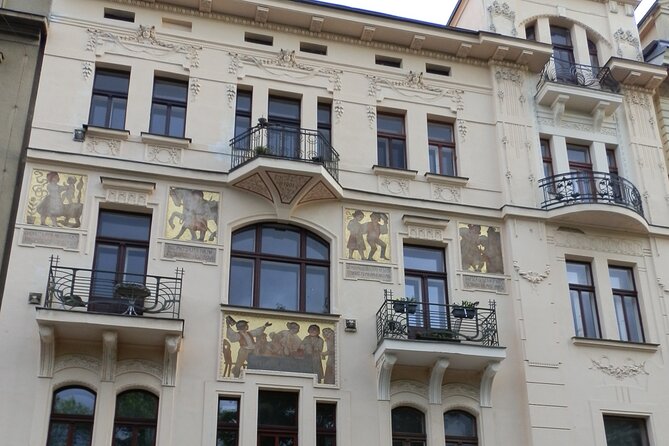
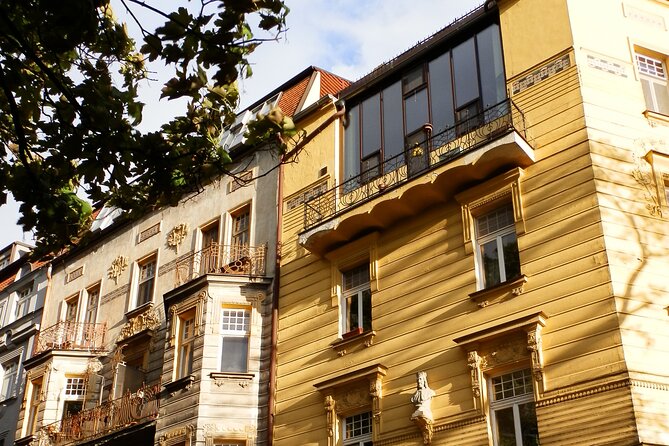
At Senovážné náměstí, the tour focuses on a small cluster of three luxurious art nouveau apartment buildings. This is a smart choice because it shifts your attention away from one landmark and onto the kind of architecture real residents would have seen every day.
Admission is free here. That makes it a good time to slow down and really look at façade rhythm, window spacing, and ornamental emphasis, because the buildings are close enough to compare quickly.
Hotel Central Palác on Hybernská 10: Early Art Nouveau in the Street Wall
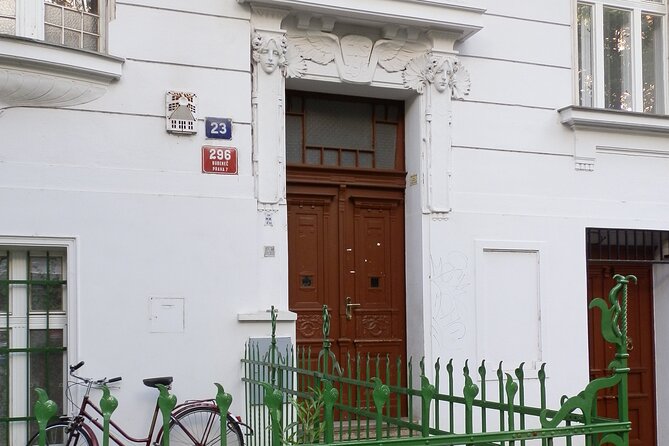
Then you move to Hybernská 10 Hotel Central Palác, dating to 1899. The tour frames it as one of Prague’s earliest art nouveau buildings, which helps you see the movement forming rather than only seeing it after it matured.
Admission is not included, so this is primarily a look-from-the-street stop. Still, those exterior moments matter. Standing here after Senovážné náměstí gives you a second reference point in time, which makes the early-versus-later feel easier to grasp.
If you like design details, this is a good place to ask your guide what to look for. A good guide can turn a façade into a checklist.
Obecní dům: When Culture and Style Share the Same Building
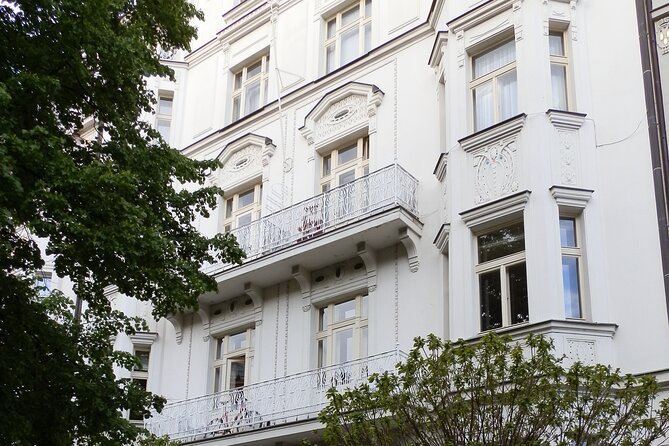
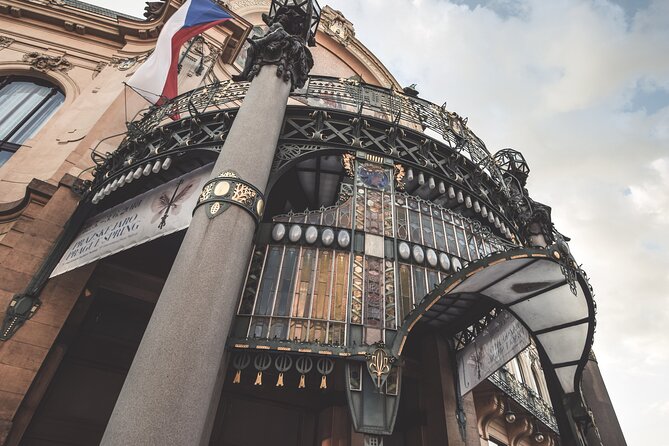
The tour brings you to Obecní dům, the Municipal House of Prague, projected in 1905. It still serves as a house of culture and representation, and the tour stresses it as one of the biggest and most important art nouveau pieces in Prague.
Admission is not included for this stop. Even so, it is worth seeing because it connects art nouveau to civic pride. When a city chooses to build a cultural house in an expressive style, it signals that design is not just decoration, it is identity.
If your schedule is tight, you can still get value here by focusing on the building’s overall statement rather than trying to capture everything in one go.
The Cubist Turn: House of the Black Madonna
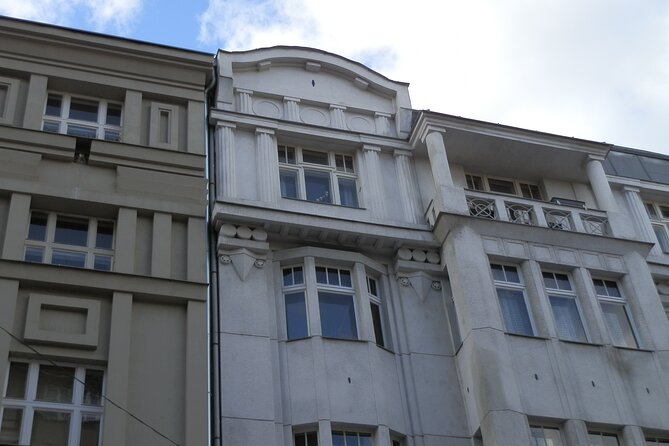
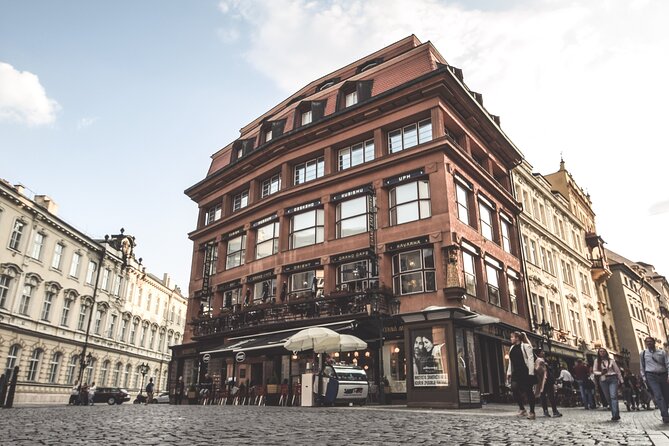
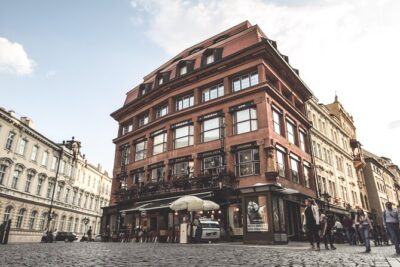
This is the moment when the tour’s visual logic gets more interesting. The House at the Black Madonna (House of the Black Madonna) is presented as the flagship of cubist architecture, pioneered by Prague architects before World War I, and built in 1912.
The tour also calls out its central location and stylistic purity. That basically means you are not being sent to a vague “maybe cubist” corner. You are going to a place that reads clearly in terms of style.
Admission is not included, so your time is for looking closely from outside. But if you pay attention to what changes from the art nouveau stops, you will start to see why cubism feels more like structure and angles than ornament.
Na Příkopě and Vácslavské náměstí: Art Nouveau on the Boulevard, Cubism in Your Periphery
After the Cubist anchor, the route shifts through central streets that are packed with visual clues.
- Na Příkopě is described as a borderline boulevard between Old Town and New Town, with several bank and other buildings in breathtaking art nouveau style. Admission is free, so you can take quick looks as you pass.
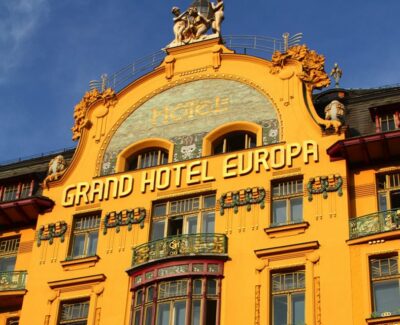
- Václavské náměstí is a major downtown square with art nouveau hotels and department stores. The tour allots more time here, about 20 minutes, which suggests you will not just glance and move on.
This pair of stops is great for training your eye. Even if you are not visiting interiors, the street layout helps. You get to see how art nouveau buildings sit side-by-side, and how a big square changes how façades feel.
Vodičkova: A Street With Both Movements in View
Then comes Vodičkova, described as home to multiple breathtaking art nouveau and cubist buildings. Admission is free.
This is one of those stops that feels like a shortcut to learning. Rather than separating movements too strictly, you see them coexisting in the same corridor of the city. It is easier to notice the differences when both styles show up close to each other.
If you are the type who likes to photograph buildings, this is where your phone camera will start working overtime.
Emil Kralíček’s Cubist Lamppost: Street Furniture Worth Stopping For
Next you see Emil Kralíček’s Cubist Lamppost, described as a unique piece of street furniture and one of the most radical interventions cubism added to Prague.
Admission is free. And that is a huge part of its value. You are not spending time buying tickets. You are spending time staring at something that makes the whole style feel modern.
This is also where the tour’s storytelling style shows up. A lamppost is a small object, but it becomes a design statement. If you only think of architecture as buildings, this stop corrects that.
Three Cubist Houses Under Vyšehrad Rock: The Famous Trio
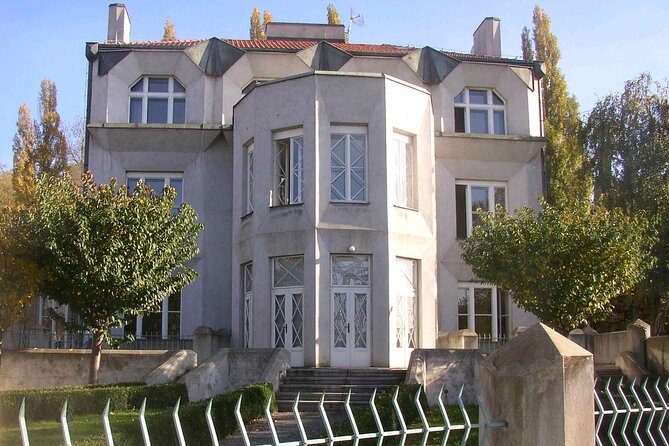
The route continues to Three Cubist Houses, a triplet of houses under the rock of Vyšehrad fortress. The tour notes it as one of the most famous cubist constructions in Prague.
Admission is not included here, so you view it from outside. Still, this is exactly the type of landmark you want to see with context, because the name alone does not teach you what makes them cubist in a way you can recognize.
In practice, this stop is one of the best “aha moments.” By now, the art nouveau part of the walk gives you contrast, so cubism reads faster.
Villa Kovařovic by the Vltava: Gothic and Baroque Inspiration With Cubist Form
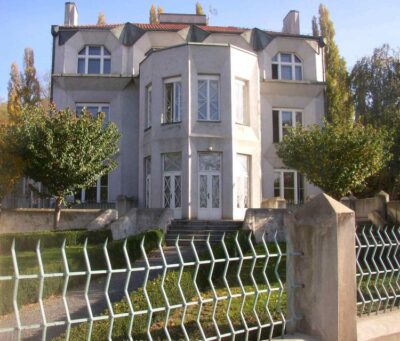
Then you reach Villa Kovařovic, built in 1912 on the Vltava river banks. The description says it is inspired by gothic and baroque architecture, but built as a cubist masterpiece.
Admission is not included. But that mix of inspirations is the point. This is where you can see that cubism in Prague did not mean one narrow look. It could work with older influences in a new language.
If you like architecture that looks like it is thinking in three directions at once, this is the stop that often keeps people looking longer.
Neklanova Finish: A 1913 Cubist Apartment Building to Wrap It Up
The tour ends at Neklanova, described as a street concluding with an amazing cubist apartment building from 1913. Admission is free.
After this, the tour concludes at the Albertov tram stop, and the note is useful: the ticket used for public transportation is still valid long enough to get you back toward the city center.
That last leg matters. It means you are not stranded at some random outer stop where you need to plan your next move from scratch.
How to Watch So You Can Spot Art Nouveau vs Cubism Later
A big reason people rate this tour highly is that it helps you start recognizing the styles yourself by the end. Here is how to do that without turning the walk into homework.
I suggest you pick just two things to track on each façade:
- Style mood: does the building feel more decorative and flowing, or more angular and structured?
- Geometric logic: does it lean toward sharp planes and breaking lines, or toward organic curves and ornament?
You do not need to memorize dates or names while you are standing there. Use the buildings as your anchor points. The tour gives you dated references like 1909 for Prague Main Station, 1906 for Jerusalem Synagogue, 1899 for Hotel Central, 1912 for House of the Black Madonna, and 1912 again for Villa Kovařovic. Those dates work like mental bookends.
Walking, Pace, and Practical Comfort Tips
This experience is listed as near public transportation, and it includes short walks between points plus some transport at one stage. That is a good setup for covering a lot without sprinting.
Still, plan on walking. The tour reviews you can find for this kind of architecture route tend to mention that the walking portion can run longer than the estimate, especially if you are stopping for photos.
My practical advice:
- Wear comfortable shoes.
- Bring a small budget for any stop where admission is not included, if you decide to enter.
- If your group has specific timing needs, ask your guide to prioritize photo points.
Also, the tour is offered in English, and it is a private tour, meaning only your group participates.
Who This Tour Is Perfect For
This is a great match if you:
- Love architecture and want to see it in the places you would walk anyway.
- Want a guided route that helps you learn how to spot art nouveau versus cubism quickly.
- Prefer a story-led approach to design, not just a list of dates.
It may be less ideal if you want a mostly indoor museum experience, or if you cannot handle standing outside for several short intervals while the guide explains what you are seeing.
Should You Book This Private Prague Art Nouveau and Cubism Walking Tour?
If your trip to Prague includes a day you want to be more design-focused, I think this is an easy yes. The tour’s value comes from its tight focus on two movements, its mix of major landmarks and street-level details, and the way the route keeps pulling you from one architectural idea to the next.
Book it if you are excited to learn by looking, and if you want a private guide from Prague Articulate, led by Max Hutar, who keeps the experience engaging. Skip it only if walking time and outdoor viewing will feel like a dealbreaker for you, since that is built into the concept.
If you do book, come ready to stare at façades like they matter. In Prague, they do.
Added recently in Prague
- Karlstejn Castle Half Day Tour from Prague★ 3.5 · 4 reviews
- Half-day Private Tour of Prague’s Charming Jewish Quarter★ 5.0 · 4 reviews
- Private Full-Day Tour Karlstejn Castle and Crystal Glassworks from Prague★ 4.5 · 4 reviews
- Prague Castle and Charles Bridge Private Walking Tour★ 5.0 · 4 reviews
- Prague: Sports Cards & Artifacts Museum Tickets★ 4.6 · 4 reviews
- Prague: Target Gun Shooting Experience with Hotel Pickup★ 4.7 · 4 reviews
- Private tour to Cesky Krumlov★ 5.0 · 4 reviews
- Prague Airport Transfers, Praga Aeropuerto Traslados, ESPAŇOL-ENG★ 5.0 · 4 reviews
Art Nouveau & Cubism, compared.
Private Prague Art Nouveau and Cubism Walking Tour
Read our review →
Browse the lists this tour appears in