Reviewed · TOURS
Kafka’s Prague Small Group Tour
Franz Kafka’s Prague Small Group Tour is interesting because it uses real street addresses to explain why Prague feels so psychological on the page. Instead of just pointing at monuments, you walk through the city like it’s a living notebook.
I like the small group size (max 6) because the guide can keep the pacing human and answer follow-up questions. I also like that Radek ties locations to Kafka quotes and period photos, so you get both the facts and the mood.
One thing to consider: this is a walking tour with lots of quick stops, so if you want long museum time inside specific buildings, you will feel a bit limited. Still, the structure is excellent for getting your bearings fast.
Key things I’d prioritize before you go
- A max group of 6 means you’re not lost in the crowd when the guide brings up details.
- Radek’s storytelling style uses hand-picked Kafka lines tied to where you are standing.
- Pictures from then vs now help you see what changed when the city rebuilt parts of the Jewish quarter.
- 15 focused stops in about 3 hours, mostly exterior, with short, satisfying time at each location.
- Cafe Louvre finish with your drink included, so the tour ends in a real place Kafka would have recognized.
Why Kafka’s Prague feels different on foot
Prague can feel like a postcard city, but Kafka’s Prague feels like a set of clues. This tour leans into that. You’re not hunting for abstract “Kafka vibes.” You’re standing where Kafka was born, went to school, worked, studied law, and spent his last days.
The best part is how the tour builds a cause-and-effect storyline. You start with family and formation, move into the young writer years, then shift into education and work, and finally land on the places that connect to illness and the end of his Prague chapter. It’s a tight arc.
And because everything happens in a small group, you can actually keep up. When a guide can look at the whole group, they can pace you better and keep the important links clear.
In the same part of Prague:
- Prague: 50-Minute Sightseeing Evening Cruise
★ 4.2 · 33,780 reviews - Prague: Medieval Dinner with Unlimited Drinks
★ 4.4 · 19,847 reviews - Prague: Skip-the-line Castle Ticket and Optional AudioGuide
★ 4.3 · 11,121 reviews
Meet Radek Local Guide and how the tour is paced
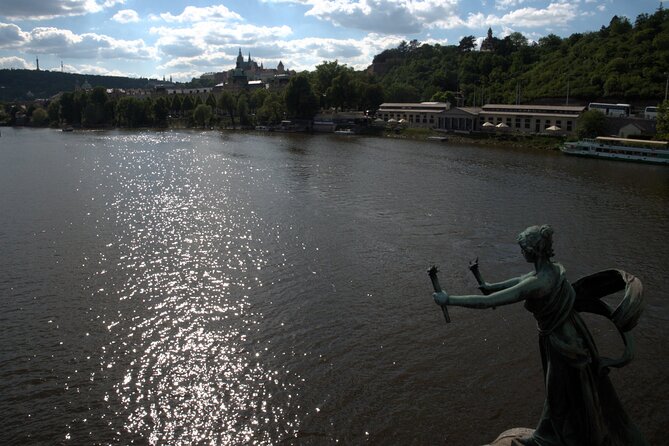
This is offered in English and runs for about 3 hours. The group size tops out at 6 travelers, which matters more than you might think. Prague is big enough to scatter people, even in the center. Here, you stay close, you hear the explanations, and you don’t waste the best part of the day doing catch-up.
Radek’s approach stands out in two practical ways. First, he uses hand-picked Kafka quotes that connect to what you’re looking at. That keeps you from leaving with only dates and addresses. Second, he shows photos of buildings as they looked then versus what’s in front of you now. Seeing the physical change makes the stories feel less like trivia and more like lived reality.
The stop durations are short and intentional. Many locations are around 5 to 10 minutes. That means you get variety without turning it into a marathon. You will still walk quite a bit though, so plan on comfortable shoes and a water break.
Kafka’s birthplace, the first school years, and the city as a family map
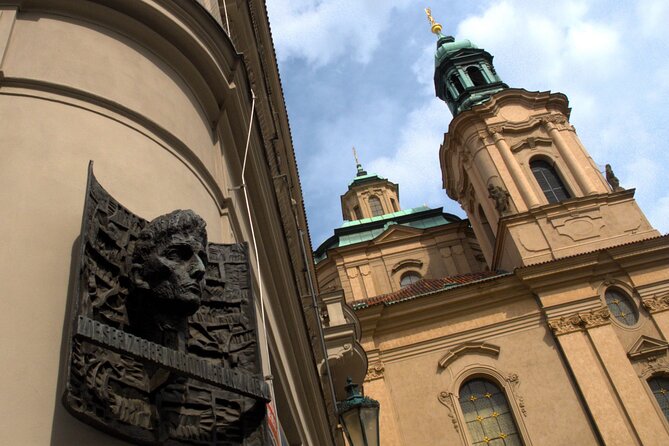
You begin at Nám. Franze Kafky 24/3 in Staré Město, at a façade relief commemorating Kafka’s birth in 1883. The actual house where he was born no longer exists, which is a good lesson right away. Prague keeps rewriting itself. This tour doesn’t pretend the past stayed perfectly preserved. It uses what remains.
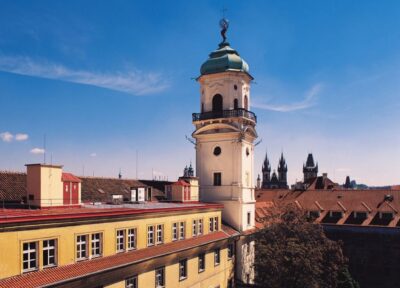
From there, you move to Staroměstské nám. 3/2 at the House at the Minute. Kafka spent part of his childhood here, and it’s tied to early schooling and family milestones, including where his sisters were born. What I like about this stop is the attention to small architectural tells, like the Renaissance sgraffito on the façade and the stone lion symbol. It’s the kind of detail you’d miss if you were only taking photos.
Next, you reach Celetná 602/3, the House of the Three Kings. Here the focus shifts to adolescence and the practical side of making a life: he had his own room with a desk for first literary attempts, and the address also connects to student years nearby at the university area and the tense national riots between Czechs and Germans.
These first three stops do one job extremely well: they show that Kafka didn’t “arrive” in Prague as an abstract writer. He grew up inside the city’s rhythms, classrooms, and conflicts.
The addresses that shape the young writer: desk years to school-leaving days
Your fourth stop is Kinsky Palace, a place tied to Kafka’s education. By the late 19th century, the K. K. State German Language Secondary School in Prague operated here, where Kafka was a student and received his school-leaving certificate. The tour also points out that the palace was at one time connected to a shop run by his father, Hermann Kafka.
This matters because it frames a Kafka contradiction you may already sense in his work. He’s often associated with rules and institutions. Here, you see that he didn’t start out with rebellion. He started inside systems, learning how they work, and later writing about what happens when they don’t make sense.
Then you head to Dlouhá 705/16, the Art Nouveau apartment house called At the Golden Pike. Built in 1914, Kafka moved there a year later and lived almost two years. This is the tour’s “writer in a room” moment, and it lands well after the school and childhood stops.
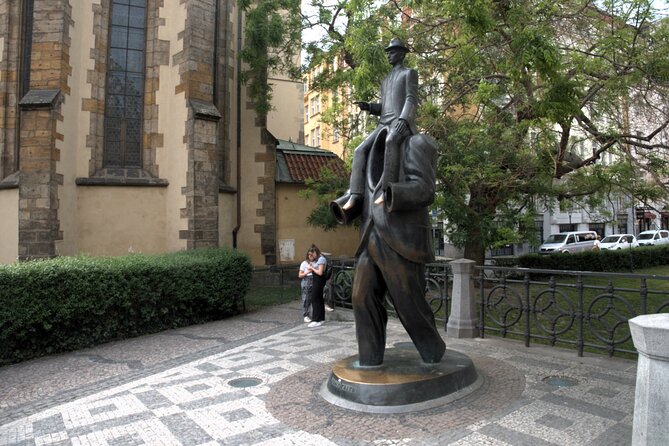
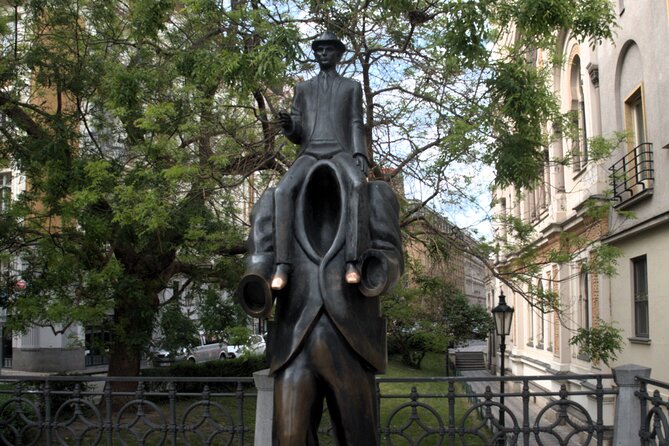
After that, you stand at the Statue of Franz Kafka by Jaroslav Rona. It’s inspired by Kafka’s short story A Description of a Struggle and also references Metamorphosis. I like this stop because it turns the abstract symbolism of Kafka’s writing into a public, physical form. You’re not just told what to feel. You see a monument that is built to trigger the feeling.
Something different for an afternoon in Prague:
- Prague: Castle Tour with Local Guide and Entry Ticket
★ 4.6 · 10,422 reviews - Prague: Oldtown, Medieval Underground & Dungeon History Tour
★ 4.3 · 10,277 reviews - Prague Castle 2.5-Hour Tour Including Admission Ticket
★ 4.7 · 8,927 reviews - Prague: Vltava River Night Cruise with Buffet
★ 4.3 · 7,338 reviews
From writing and identity to the ghetto transformation
A short walk brings you to Pařížská 36, the House of the Ship, which is linked to Kafka writing his most famous short story, Metamorphosis. Even if you’ve read the story many times, standing at the address can change how you interpret the feeling of displacement. The tour doesn’t need to dramatize it. The city itself does the heavy lifting.
Then the route moves into Jewish Prague with a stop at the Old-New Synagogue. This is where the tour adds weight and nuance. In Kafka’s childhood and youth, the former Jewish quarter was being fundamentally transformed, with poorer old houses demolished and replaced by luxury apartment blocks. Only a few buildings remain from the original ghetto, and the Old-New Synagogue is one of them.
You’ll also learn about Kafka’s relationship with Judaism here. I appreciate that this stop isn’t treated like a checklist item. The contrast between what was replaced and what survived is the point. It’s a reminder that identity and memory in Prague are partly about what gets preserved, and partly about what gets erased.
Old Town Square, illness, and Kafka’s last Prague address
At Staroměstské nám. 934/5, you reach Kafka’s last address in Prague, the Oppelt House on Old Town Square. This stop connects directly to his advanced lung disease and the period just before his death, when he lived in the care of his parents.
This is where the tour tone becomes more reflective. It’s not spooky, and it isn’t trying to force tears. It’s practical and human. You can look around the square and think about how a person can be physically in a busy public space while privately facing a shrinking timeline.
If you are the kind of reader who wants the real-world shape behind the emotional themes, this is one of the most satisfying parts of the tour. It ties location to a life stage, not just a literary reference.
University and the law: how Prague’s institutions feed his themes
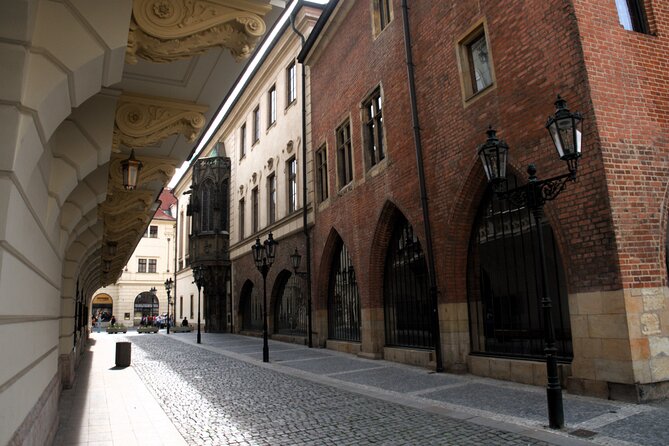
Next, you visit Karolinum, the building tied to Kafka’s university education at the German Karl-Ferdinand University. The tour notes that he received his doctorate in law in the mid-14th-century Karolinum building. It’s a strong bridge between biography and the particular “systems” vibe you see across his writing.
Then you stop at Ovocný trh 14, the State Civil Court building where Kafka spent part of his compulsory legal clerkship during his university studies. The tour connects the endless corridors, waiting rooms, and courtrooms to inspiration for The Trial.
Even if you’ve read The Trial and already know the theme, this stop helps you understand the atmosphere as something concrete. Courts aren’t just settings. They are emotional machines: you wait, you watch, you hope, you feel unheard. Kafka’s fiction turns that into literature, and the building gives you the physical reference.
Finally, you move to Na Poříčí 17, the former Workers’ Insurance Company for the Kingdom of Bohemia, where Kafka worked until health forced him to retire. This turns the “legal Prague” theme into a “work Prague” theme. You see that his contact with institutions wasn’t only student theory.
Café culture and two Kafka monuments that you can’t miss
At Hybernská 1004/16, the tour stops at Cafe Arco, described as one of Kafka’s favorite places and connected to cultural life at the time. This is a smart inclusion because it reminds you that Kafka’s world wasn’t only law and buildings. It included people, conversation, and daily life.
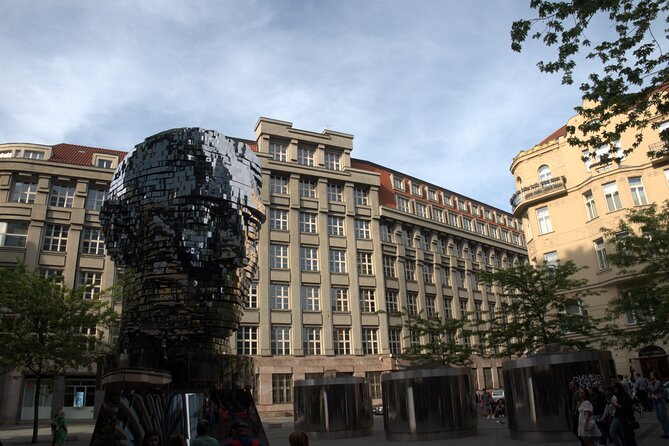
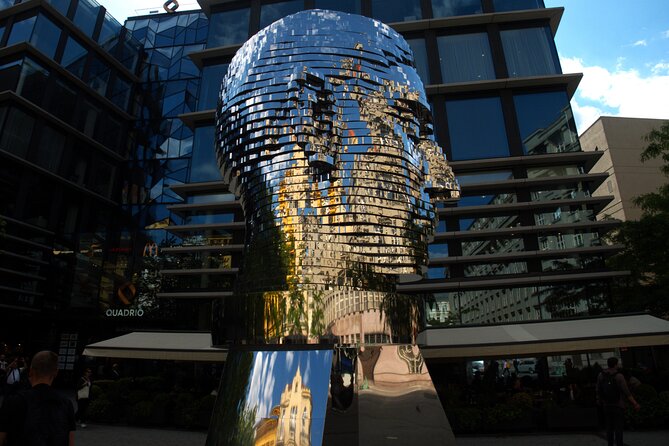
Then comes a more modern memorial moment: Franz Kafka – Rotating Head by David Černy. This is the famous mechanical rotating statue depicting Kafka’s head, and the tour explains it as one of the most recognized Kafka monuments today. I like having this stop after the older addresses because it shows how Kafka’s influence keeps moving forward. Prague didn’t stop caring about him once the writer was gone.
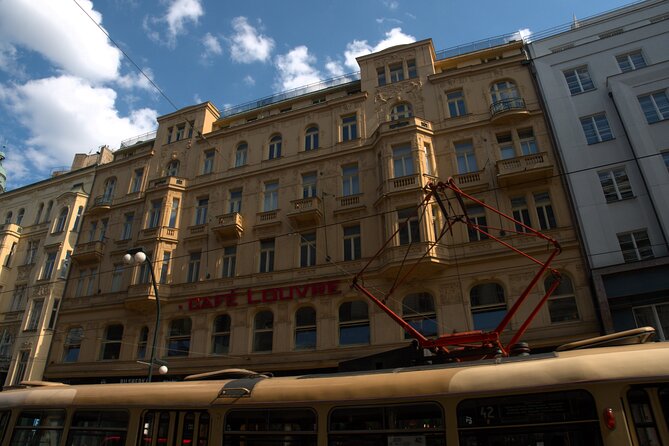
A bit later, you reach Národní 1987/22 for Cafe Louvre, another important cultural place tied to the time. The tour encourages you to stay a little longer here. You’ll sit for a short drink, and the price of your drink is included in the tour cost.
This ending works for practical reasons too. By the time you reach the café, you’re likely to want a break and a place to think. Cafe Louvre gives you both, and it finishes the walking arc with a pause rather than a final sprint to the next landmark.
The route from Old Town to New Town: what to expect on the ground
The tour starts in Staré Město and ends at Cafe Louvre near the border between Old Town and New Town, Národní 1987/22. It’s easy to get around central Prague afterward, either on foot or using nearby public transportation.
What I’d tell you to watch for is pacing. Because each stop is brief, the tour works best if you stay mentally switched on. If you drift into photo-taking mode at every corner, you may miss the quote or the key “why this place matters” explanation.
The good news is the structure is forgiving. You are not asked to remember complicated logistics. Each stop is designed to be a self-contained story beat, and Radek’s narration keeps the thread clear.
Also, the tour uses a mobile ticket, and you’ll have time to regroup as you move between stops. Service animals are allowed, and the tour is near public transportation, so if you need to step out briefly for any reason, it’s not an isolated experience.
Price and value: why $34.30 can work out well
At $34.30 per person for about 3 hours, this tour sits in a reasonable value zone for a guide-led experience in the center of Prague. Here’s why the value makes sense for this specific tour:
- You get a small group with a named guide, not a huge herd.
- Many stops are listed as Admission Ticket Free, so you’re paying mainly for interpretation and guided walking rather than museum entry fees.
- The tour includes a drink at Café Louvre, which turns the final stop from a “suggested extra” into a real part of the experience.
The only potential downside on value is the trade-off between walking pace and depth. You are seeing a lot of addresses in a short time, so you’re not getting long interior sessions. If your ideal Prague day is slow museum time, you may wish you had more quiet hours. If your ideal day is understanding a city through a single writer’s trail, this price feels fair.
Who this tour suits best, and who might want to skip it
This is ideal if you:
- love literature and want to connect biography to place
- enjoy walking tours that keep momentum but still explain the “why”
- want a small group experience led by Radek
- want to understand Kafka beyond plot summaries, through locations and themes like education, work, law, and identity
You might think about skipping or pairing it with something else if you:
- want lots of long indoor museum time
- struggle with sustained walking on a tight schedule
- prefer broad city history over a focused theme
Should you book Kafka’s Prague Small Group Tour?
Yes, if you want a guided path through Prague that turns addresses into story logic. The biggest reasons are practical: max 6 people, Radek’s ability to connect Kafka lines to the street corner you’re standing on, and the smart ending at Cafe Louvre with your drink included.
It’s also a good first Kafka tour in Prague. You’ll leave with a clear mental map: birthplace commemorated on the façade, school-connected landmarks, the law and court environment tied to The Trial, and the final Prague address near the end of his life.
If you are a Kafka fan who wants to feel the city instead of just reading about it, this is a solid bet.
Added recently in Prague
- Inside Jewish Prague: A Journey Through Time★ 4.7 · 3 reviews
- Gourmet Brunch with Chef: Unlimited Drinks & Stunning River Views★ 5.0 · 3 reviews
- Private walking tour and Boat cruise Best of Prague★ 5.0 · 3 reviews
- Prague: Mozart, Dvořák, Czech Folk Tour with a Guitarist★ 5.0 · 3 reviews
- Prague to Karlovy Vary Private Transfer★ 4.5 · 3 reviews
- Prague Tour in Spanish★ 5.0 · 3 reviews
- Learn Traditional Czech Cooking from Authentic Family Recipes★ 5.0 · 3 reviews
- Full Day Private Tour Through Prague★ 5.0 · 3 reviews
Tours, compared.
Castle Tour with Local Guide and Entry Ticket
Read our review →
Oldtown, Medieval Underground & Dungeon History Tour
Read our review →
Prague Castle 2.5-Hour Tour Including Admission Ticket
Read our review →
3-Hour Walking Tour of Old Town & Prague Castle
Read our review →
3-Hour Old Town and Prague Castle Tour in German
Read our review →
Ghost Walking Tour Where Legends Come To Life
Read our review →
Ghosts, Legends, Medieval Underground & Dungeon Tour
Read our review →